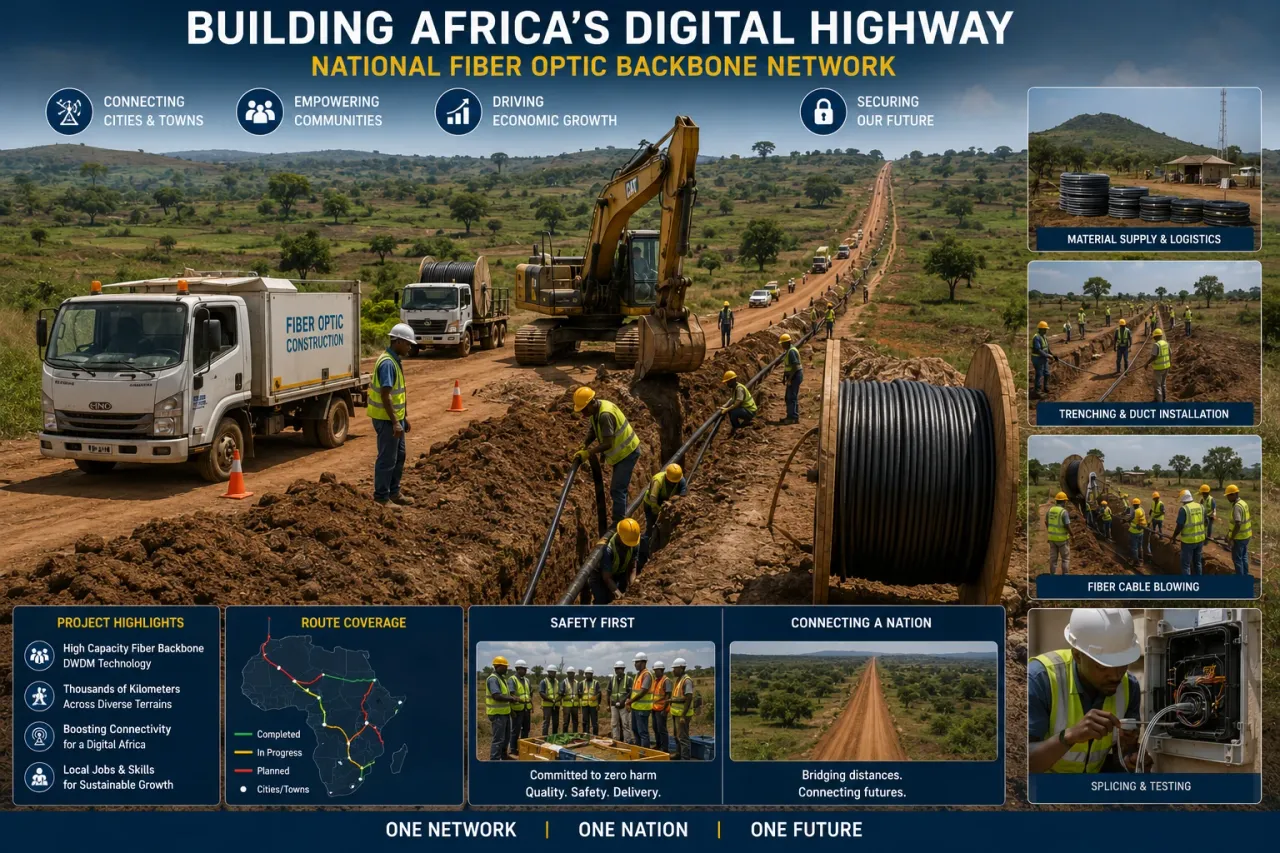
Every call, video and online transaction in a country travels over its backbone: the high-capacity fibre network that links cities and towns. Building that backbone is some of the most important infrastructure work in Africa today.
Why backbones matter
- Connecting cities and towns into one national network.
- Empowering communities with access to digital services.
- Driving economic growth for businesses of every size.
- Securing our future with infrastructure built to last.
How a backbone is built
Material supply and logistics
A backbone route can run for hundreds of kilometres through remote terrain. Ducts, cable drums and equipment have to arrive at the right place at the right time, so logistics planning comes before the first trench is dug.
Trenching and duct installation
Crews and excavators open the trench along the route and lay protective ducts, following the surveyed alignment and keeping road users safe.
Fibre cable blowing
The fibre cable is blown into the duct on compressed air, which protects it and lets long sections be installed quickly.
Splicing and testing
Cable sections are joined by fusion splicing inside closures and cabinets, then tested along their full length before the route is handed over.
Built for capacity
A national backbone is designed for high capacity, typically using DWDM (dense wavelength division multiplexing) technology to carry many wavelengths of light over the same fibre. Routes cross thousands of kilometres of diverse terrain, and the work creates local jobs and skills for sustainable growth.
Safety first
Linear projects move every day, which makes safety briefings, PPE and traffic management essential. We are committed to zero harm: quality, safety, delivery.
Bridging distances. Connecting futures.
Comments & reviews
No comments yet. Be the first to share your thoughts.