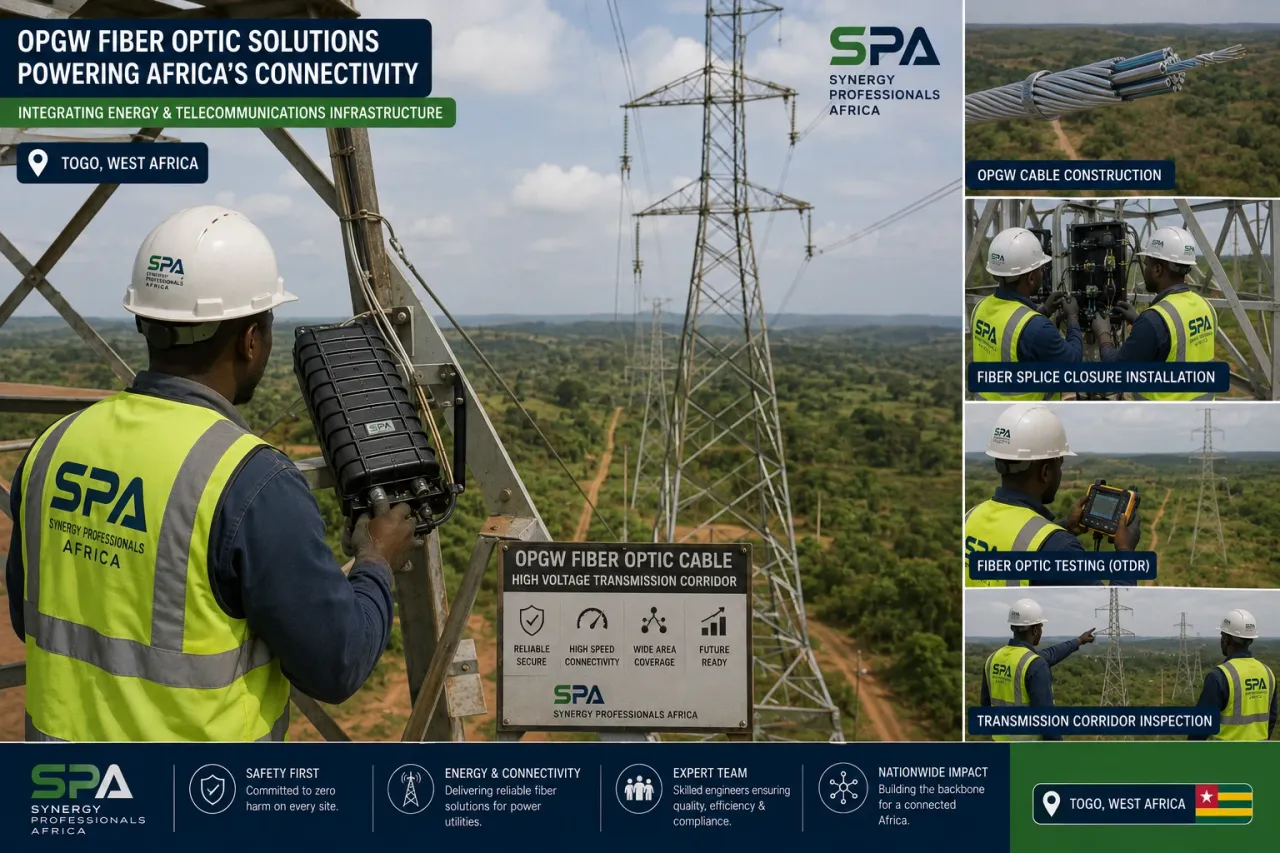
Some of the most efficient routes for long-distance fibre already exist: the high-voltage transmission lines that cross the country. In Togo, West Africa, our teams work on OPGW fibre optic solutions that integrate energy and telecommunications infrastructure.
What OPGW is
Optical ground wire (OPGW) is the earth wire strung along the top of a transmission line, with optical fibres protected inside its core. It does two jobs at once: it shields the power conductors from lightning, and it carries a fibre optic network along the entire corridor.
The work on the corridor
OPGW cable construction
Steel and aluminium strands surround protective tubes that hold the fibres. That construction gives the cable the strength to span between towers and the conductivity to act as an earth wire.
Fibre splice closure installation
Cable lengths are joined at splice closures mounted on the towers. Our engineers work at height to fit the closures and splice the fibres inside, sealing them against weather.
Fibre optic testing (OTDR)
Every section is tested with an optical time-domain reflectometer (OTDR), which measures loss along the fibre and pinpoints any fault, so the link is proven before it goes into service.
Transmission corridor inspection
Teams walk and inspect the corridor to check towers, fittings and access, keeping the route safe and ready for maintenance.
Why it matters
- Reliable and secure: fibre carried high above the ground.
- High-speed connectivity with wide area coverage.
- Energy and connectivity: reliable fibre solutions for power utilities.
- Future ready: capacity for the grid and for telecoms.
Our expert team of skilled engineers works to ensure quality, efficiency and compliance, with safety first on every site.


Comments & reviews
No comments yet. Be the first to share your thoughts.