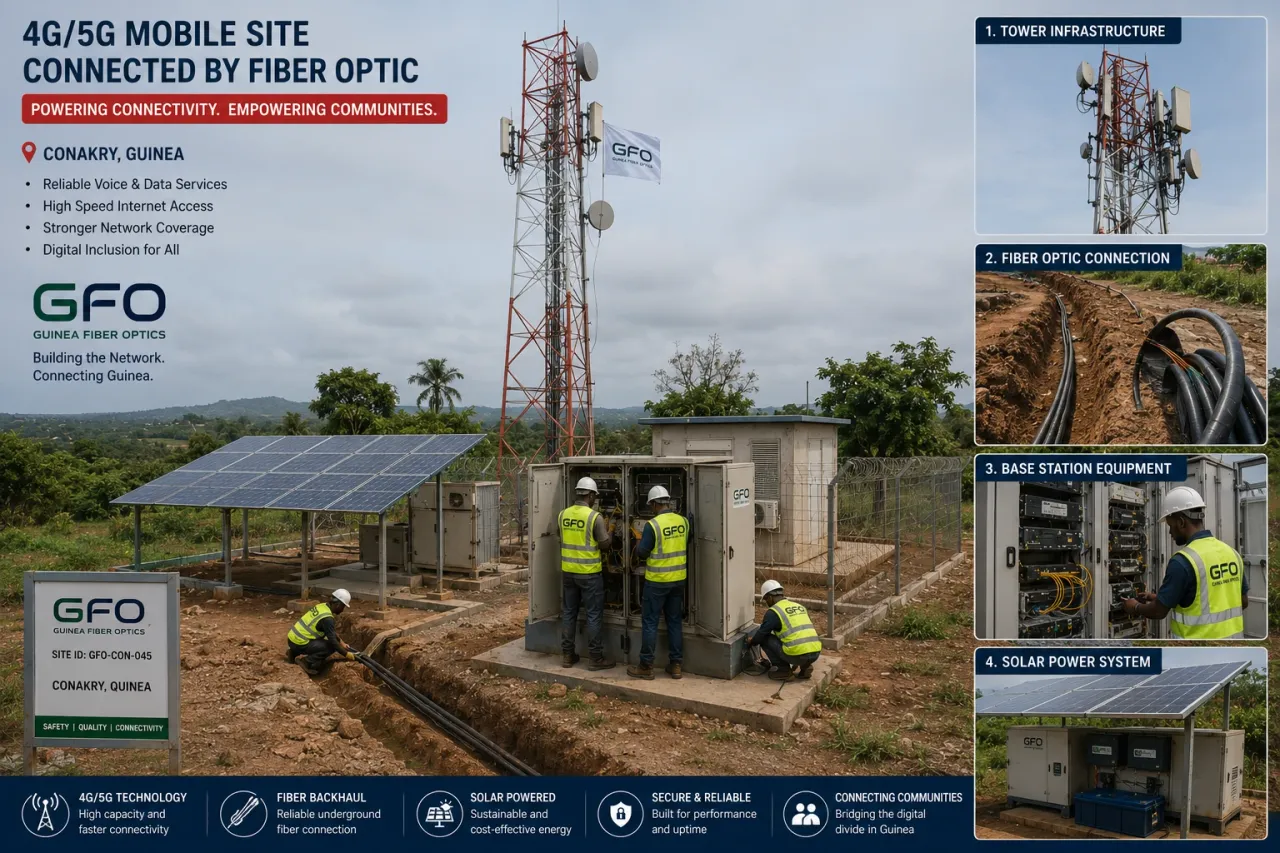
A mobile site is only as good as the link behind it. The radios on a tower can support 4G and 5G speeds, but every call, message and download still has to travel back into the core network. On this site in Conakry, Guinea, that link is fibre optic.
The work was carried out at a Guinea Fiber Optics (GFO) site, identified on its signboard as GFO-CON-045. The goal is set out plainly on the project board: reliable voice and data services, high-speed internet access, stronger network coverage and digital inclusion for all.
Four systems, one site
1. Tower infrastructure
The lattice tower carries the sector antennas that serve the surrounding area and the microwave dishes used for point-to-point links. The antennas need a clear view of the coverage area, which is why height and placement matter as much as the equipment itself.
2. The fibre optic connection
Instead of relying only on microwave, the site is connected by fibre laid in an underground trench. Fibre backhaul carries far more capacity than radio links and is not affected by weather or line-of-sight, so it is the natural choice for sites expected to carry 4G and 5G traffic.
3. Base station equipment
Inside the outdoor cabinets, the team terminates the incoming fibre and connects it to the base station equipment. Neat patching, labelling and testing at this stage make the site far easier to maintain for years afterwards.
4. Solar power system
A ground-mounted solar array and battery storage keep the site running. Solar power cuts fuel costs and keeps the site on air where the grid is unreliable.
Why it matters
- 4G/5G technology: high capacity and faster connectivity.
- Fibre backhaul: a reliable underground connection to the network.
- Solar powered: sustainable, cost-effective energy.
- Secure and reliable: built for performance and uptime.
- Connecting communities: helping to bridge the digital divide in Guinea.
As the site board puts it: safety, quality, connectivity.
Comments & reviews
No comments yet. Be the first to share your thoughts.