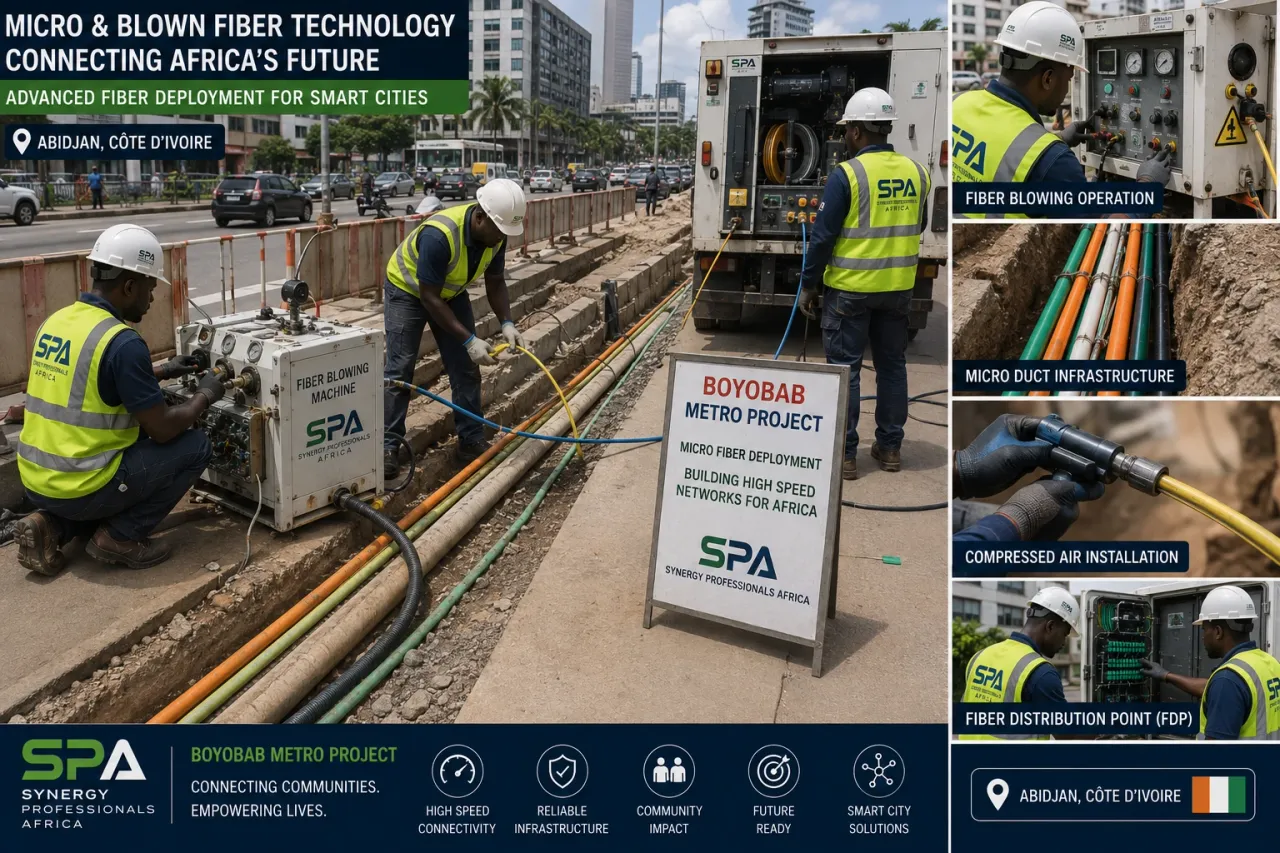
Cities are hard places to lay cable. Roads are busy, space under the pavement is crowded and every open trench disrupts someone. On the Boyobab Metro Project in Abidjan, Côte d'Ivoire, our teams are using micro and blown fibre technology to build high-speed networks with less disruption.
How blown fibre works
Micro duct infrastructure
Bundles of small, colour-coded micro ducts are laid in a single shallow trench. Each duct is a ready-made pathway for a future cable, so capacity can be added later without digging the road up again.
The fibre blowing operation
A fibre blowing machine pushes the cable into the duct while compressed air carries it along. The cable floats on the airflow instead of being dragged, which protects the fibre and allows long distances to be installed in a single run.
Compressed air installation
Air is fed into the duct under controlled pressure. Operators watch the machine's gauges throughout, adjusting speed and pressure to suit the route.
The fibre distribution point (FDP)
At the end of the route, the fibre is terminated at a distribution point where it is spliced, patched and made ready to serve customers.
Why it suits smart cities
- High-speed connectivity delivered over fibre.
- Reliable infrastructure protected inside ducts.
- Community impact: smaller trenches and shorter works on busy streets.
- Future ready: spare ducts leave room for growth.
- Smart city solutions built on a scalable network.
Connecting communities. Empowering lives.
Comments & reviews
No comments yet. Be the first to share your thoughts.